Capybara
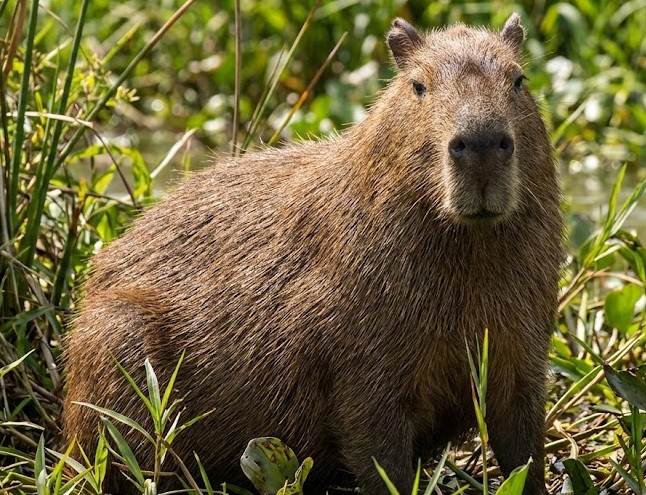
The capybara is the largest known rodent in the world and is found everywhere in South America with the exception of Chile. It is related to animals like guinea pigs, and more distantly, chinchillas. It tends to live near water – rivers, ponds, lakes, swamps, marshes etc. This rodent is semi-aquatic and breeds in water though its young are born on land. It can even sleep in water through its nose.
A capybara is extremely sociable and may live in groups of 50 to 100, although groups of 10 – 20 are more likely. It is not an endangered species (due to its rapid rate of reproduction) however, it is hunted for its meat, pelts and because some see it as a threat to other wildlife stock.
It has a heavy, barrel-shaped body and can grow up to 4.40 feet in length, can stand 24 inches from its withers, and often weighs up to 146 lbs. The females are usually heavier than the males. Interestingly, their hind legs are a bit longer than their forelegs and they have slightly webbed feet; they have 3 toes on their rear feet and 4 toes on their front feet. Also, their muzzles are blunt and their ears, eyes and nostrils are near the top of its head.
The diet of a capybara is somewhat limited with it mainly living on aquatic plants, grasses, tree bark and fruit. They are very particular about which leaves they feed on, although they do eat a variety of plants during the dry season like reeds. Perhaps a less attractive feature of this rodent is that it eats its own faeces in an effort to digest cellulose in grass and to extract more protein and vitamins from food. It also regurgitates food in order to masticate it again. Because of its dietary activities, its front teeth grow all the time as does its cheek teeth.
A capybara can live in the wild until it is 8 or 10 but this is unlikely because of predators such as: cougars, jaguars, green anacondas, piranhas, caimans and harpy eagles. Consequently, they are lucky to live 4 years. In captivity they have been known to live 12 years.
The gestation period of a capybara is 130 – 150 days, and within a week of being born, the young can eat but continue to suckle from any female in the group until they are 16 weeks of age. The young form a group within the main group.
This rodent has various means of communication like barks, purrs, chirps and during oestrus, a female may whistle through her nose to attract males. It also scent-marks to communicate with other capybaras.
To conclude, the capybara is yet another of our world’s wonderful creatures that deserve our utmost respect.