
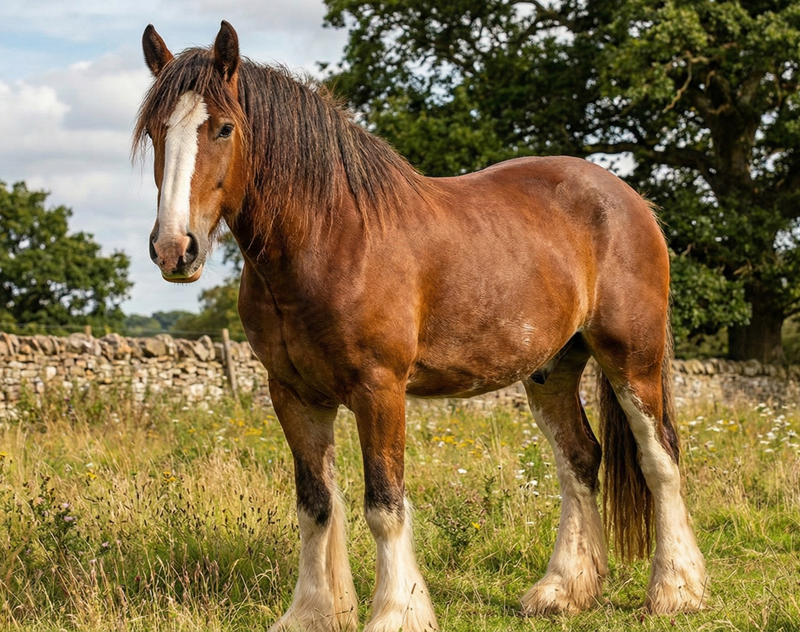
Shire Horse
The Shire Horse is the result of selective breeding undertaken by people like Robert Bakewell in the seventeenth century who introduced the “Bakewell Black” or “Lincolnshire Black” variety.
Shire horses were originally used for heavy work like farm work, forestry, delivering beer and for transporting other goods by road. They were even strong enough to tow barges on the canals.
A shire horse is indeed of impressive stature with the average height of a grown stallion being 17.2 hands and weighing between 850 and 1100 kg. In fact, the tallest and heaviest shire horse recorded, in 1846, was one called Sampson which stood at over 21.2 hands and weighed an incredible 1524 kg.
The head of a shire horse is distinct from other breeds with a lean, long neck which is slightly arched and long relative to the size of its body. It is indeed aesthetically pleasing. Unfortunately, because of its build, it is prone to Chronic Progressive Lymphoedema which can be very debilitating and painful.
At its peak, there were over a million shire horses in the UK and business flourished transporting thousands of them to the US, beginning in 1853. However, with increasing mechanisation and changing rules on the purchase of livestock food, the breed was considered superfluous, and as a result, thousands were slaughtered and breeding studs closed down.
Happily, due to public interest in the seventies, the breed started to become popular again with breed societies popping up in France, Germany, Canada, the Netherlands and in the US. In 1996, the first Shire Horse Congress was held in Peterborough. The breed is still considered to be at risk and needs to be preserved for every generation to enjoy.
Today shire horses are still employed in ploughing, logging and there are still a few breweries who employ them for traditional dray work. They are a magnificent animal.
* Ref. Wikipedia