Hare
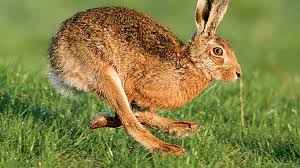
The hare is an interesting mammal that is exclusively herbivore. It differs from rabbits in size and it’s young are quickly capable of fending for themselves as they are born fully-furred and with their eyes wide open – rabbits are born blind and hairless. A hare that is less than one year old is called a leveret and becomes a very fast runner (over 50 mph over a short distance) with powerful hind legs. It also possesses large ears which directly dissipate body heat.
This mammal is found primarily in: Eurasia, Africa and North America and has not been domesticated like rabbits. A group of hares is known as a down or husk though they usually live solitarily in pairs and nest in depressions called forms.
Although the hare is normally shy, its behaviour changes in Spring when it starts “boxing” other hares which led to the well-known expression: “Mad as A March Hare”.
Interestingly, hares are larger than rabbits with longer ears and black markings on their fur – they actually have 48 chromosomes whilst rabbits have 44.
The hare can thrive in numerous locations: mountains, swamps, tropical regions, arctic tundra, temperate grasslands and forests. It is a common source of protein for many people, but significantly, it is very low in fat content. Some cultures like the Jewish culture don’t consider the meat kosher although Muslims treat it as halal. It is a staple diet of the Maltese and is used in Jute leaf soup in Egypt.
Hares feature in many folk tales e.g. The Tortoise and The Hare. * Ref. Wikipedia