
Bobcat
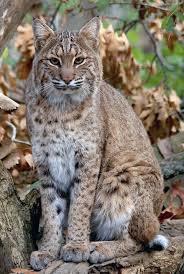
The bobcat is thought to have evolved from the Eurasian lynx and is found in North America, Canada and Mexico. Its population is largely stable but it is hunted by humans for its fur and sport. Although an adult bobcat has few natural predators (cougars and wolves), it is known to have been taken by American alligators and golden eagles. Unfortunately, it’s not the same story for the its kittens whose predators are numerous e.g. foxes, bears, eagles and even other male bobcats.
A bobcat is aesthetically attractive with brown and black streaks on its body and dark lines on its forelegs and short tail; it has a nice face with yellow eyes which widen nocturnally to increase light reception, and thus, vision. A male can measure up to 50 inches in length (including the tail) and can weigh up to 40 lbs – though the average is 21 lb. It stands at 12 to 24 inches at the shoulder. The female is considerably smaller and weighs, on average, 15 lbs.
As a predator, the bobcat is quite effective preferring prey like hares, rabbits, insects, chicken geese, small rodents, birds, and if really necessary, larger prey like deer. Its choice of habitat is largely influenced by the location of its prey and seasonal abundance of it. It therefore, inhabits: wooded area, semideserts, forest, swampland and even urban areas.
The animal is usually solitary and marks its territory with claw marks, deposits of faeces and urine. It can go a long time without food, and in rare cases, individuals have been known to succumb to starvation. However, in normal situations a bobcat lives about 7 years in the wild, although one kept in captivity lived until 32 years of age.
A pair of bobcats come together to mate from winter to spring (they are not exclusive to each other), and if successful, 2 to 4 kittens are born 60 – 70 days later. Occasionally, the female produces a second litter in September of the same year. The young are born in a den and are weaned after a couple of months, usually hunting by themselves in the autumn of their birth. An individual female can produce many litters in her lifetime.
As ever, humans cause problems for other species through the creation of roads, urbanisation and hunting. We must surely do more to protect wonderful animals like the bobcat.
* Ref Wikipedia