Iguana
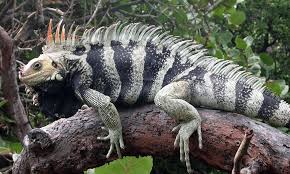
There are two classified species of iguana which are: the lesser Antillean iguana and the green iguana – the latter is often kept as pets by enthusiasts. They are an herbivorous lizard which is found in tropical areas of Central America, South America, areas of Mexico and in the Caribbean. They have also been introduced by humans to areas like Thailand, Hawaii and Singapore.
Physically, iguanas are quite imposing and, including their tail, can measure from 4 to 6.5 ft in length. Their coloration is interesting and various colourful scales are on their body e.g. they have a row of elongated scales running from the middle of their necks down to their tails. Interestingly, they also have a large, round scale located on their cheek which is known as a subtympanic scale.
The skull of an iguana has evolved to reflect its herbivorous nature and is very muscular to enable it to bite with force. It is also able to see well which helps it navigate through crowded forests and to find food. Its coloration also enables it to hide from predators.
The reproduction system of an iguana (like some other reptiles) is fascinating as the female can store sperm from a former lover’ and use it in times when it hasn’t a male. The number of eggs depends on the body size of the female, climate and environmental conditions. Mating usually occurs during the dry season so that food is bountiful when the hatchlings arrive during the wet or rainy season. Males compete for females and mark their territory with a pheromone. Unfortunately, females are often left with scars following vigorous mating.
Humans consume iguana meat in places like Central America, US, Mexico, Dominican Republic and Puerto Rico. In addition, iguana eggs are eaten in parts of Latin America such as Nicaragua and Colombia.
It can be argued that iguanas are valuable component of many ecosystems – especially where they are the largest terrestrial species. They promote plant and floral growth through their diet and are responsible for seed germination. They are also a good source of protein for their predators. Even the digging that the female undertakes to lay her eggs is useful to other species.
* Ref. Wikipedia