
Choosing The Right Setting
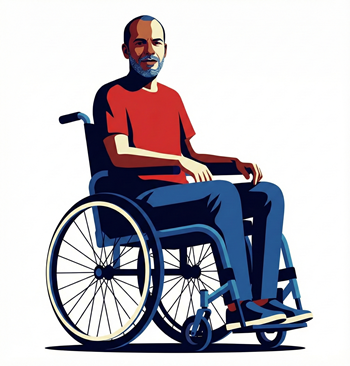
One warm evening in May, I came out of my home with an armful of washing. Ricky stood in the small atrium that lies outside my door. Atrium’s a grand word. It’s just an area where the corridor gets chubbier. Big picture windows let light in so it feels, on a good day, like God’s painting just for you. It looks over the rooftops to the low hill side beyond. In spring and autumn, the sun skids across the tree-line, joining inside and out.
This evening it was just right. I thought so in passing. Ricky knew it in a deeper place. I’ve known Ricky about seven years. Since I moved into this sheltered housing block. It’s sheltered, not supported. There are no staff on site. The residents live independently. There’s a supported living establishment across the way. In between our building and theirs, lies a garden and a car park. The geography of my memory. As I recall, the garden caused our meeting. I was picking roses from the bush beneath his window. A high, deeply set bloom brought me low. Reach. Tip. Grasp. I had the rose but the rose bush had me. I noticed, with a backward glance through his open window, Ricky moving about his flat. “Ricky!” An extended pause.
Then Ricky. His head poked out of the window, his hand on the handle. “Krishnan? Is it?” I didn’t correct him. I never have. The question was part confirmation, part introduction. “Are you alright there?” Doing the maths backwards, he must have been about 82 then and not of big build. I’m not a slight man. Five minutes later I was rescued. I had mud on my wheels.
He had his slippers on. No judgement. No embarrassment. In contrast to Ricky, there was, around that time, a stick-thin, caricature of old age living in the building. He wore a worn, knee-length raincoat, a flat cap and had a cloth bag always dangling by his side. Over the course of the first year or two I was here; I watched him deteriorate slowly with dementia.
Initially we’d share a greeting. Eventually they disappeared. He’d never looked particularly alert and bright. His humanity withered. From my window I’d watch him also waiting for the bus, cloth bag hanging unnoticed by his side. Three buses might pass, unheeded. He and Ricky were in the same year at school. They’d grown up together. Ricky told me this in a conversation in the laundry. There was care and acceptance carefully balanced in the revelation.
How do you make sense of the bullets you dodge? Soon after that, the wraith faded away. Covid helped. Not the disease. The circumstances. I didn’t see Ricky quite as often for a while either. Then restrictions lifted. Movement became freer. Thursday nights I’d find Ricky, sitting with his two sons, Andrew and Stephen. They were coming home from the Sports and Social after beer and snooker. The high point was Ricky indicating to one or other of his two boys, both a good three years older than me. “You press the button.” A pause, then. “Come on the stop’s coming up!”
The benign parental authority still active. Now here was Ricky, in the atrium, his gaze not quite purposeful but focused for all that. “It’s a lovely view, isn’t it? That sunlight on the hillside.” “Isn’t it?” His response, polite. No mention of my name. “I’m thinking of getting something to settle down here.” He indicated the general area of the atrium. “You know. Take the weight off.” The active, fatherly instinct replaced with something less sure. “I’ve got a folding chair in my flat. I can go and get it.” “No. I’ll find something. I’m just considering it right now.”
Ricky knew how to look after himself, he just needed me to turn up to prove it. He turned to face me. “Where are you going?” “The laundry.” “Oh yes.” Looking at the pile of clothes in my lap. “Of course.” A final glance out of the window. “Come on!” he said. At the lift we parted ways. He took the stairs. The lift doors opened. An empty corridor. The sound of another door opening along the way drew my attention. “There’s nobody in here.” Ricky’s head poled out from the laundry room door. “You’ve got your choice of machines!” As I got closer, Ricky stepped back allowing me in. The laundry room concierge. “I like the middle one.” He looked at the three washing machines lining the wall. “Okay.” “It does the best job.”
“I actually like the one on the left. It’s got a one hour setting that’s convenient.” I began loading my clothes into the machine. He pulled the face of a defeated comic book villain. “You’ll regret that.” Playing up to the audience of one. “I’ll bet I won’t.” I played back. To the opening strains of water filling the drum, we left. At the lift we parted, proposing more of the same, “Next time.” Ricky’s been given a present, a perpetual forget. Meanwhile, I remember many encounters imperfectly. Ricky lives I relive. History repeats itself, first as tragedy then as farce. We’ve revolutionised history. Memories are churned out on an industrial scale, to access over and over.
How to select a good way to proceed from so many available options? After tragedy and farce are played out, we’re left with the same question. What next? To answer is an act of faith. The simple sort, communicated in moments when a man with diminished abilities and strength of character is able to guide a man with diminished abilities and a lapful of washing which machine to choose. And accept the consequences with grace.