Hello again! I hope you are okay and will consider entering the competition found below.
If you think you would like to get involved with this project, please contact us (in a non-racist, non-homophobic and non-sexist way) at: dean@fthm.org.uk
Please note that our website address is: https://fromthehorsesmouth.org.uk
Dean
-
Our Autumn Competition is Still Open!

Just a quick reminder that there is still time to enter our Autumn Competition, which we launched in the October 2026 edition.
We are looking for anything that captures your creativity, personality, and idea of Autumn—whether that is a photograph, a poem, a short story, a piece of artwork, or simply a few words about what the season means to you.
It is completely FREE to enter, and we have £175 in cash prizes plus trophies up for grabs:
- Winner — From The Horse’s Mouth Winner Trophy + £100
- Second Place — From The Horse’s Mouth Runner-Up Trophy + £50
- Third Place — From The Horse’s Mouth Runner-Up Trophy + £25
Please send your entries to dean@fthm.org.uk by the closing date of 1 December 2026. The winner and runners-up will be announced in our January 2027 edition, so get creative, have fun, and show us what Autumn looks or feels like to you!
-
My Not Very Serious Stars

Scorpio 24 Oct – 22 Nov
This month, there may be fireworks in the bedroom with someone you recently met online – but do consider the possible consequences. Now that you are feeling better, make hay while the sun shines before the rain comes again. It is time to accept that you need to reduce your alcohol consumption. You still don’t know the meaning of life, but you’re are not alone.
Sagittarius 23 Nov – 21 Dec
Something really good is about to happen to you if you can just ride the huge negative wave that you are currently on. A narcissist will get on your nerves this week, so, just tell him to go away and concentrate on shaping his image. Christmas is not far away and it is time to decide if you will play the usual commercial game. Be careful what you do next Friday morning.
Capricorn 22 Dec – 20 Jan
A man with a battered shopping trolley, who laughs in the face of fashion, will astound you with his knowledge of current affairs. It is a good time to incorporate more roughage into your poor diet. Maybe take a winter holiday as you have definitely earned it. A facelift is a good idea if you are to attract that younger person who you crave. Try to lose some weight.
Aquarius 21 Jan – 19 Feb
Death is inevitable, so, do try and get on with the job of living this difficult life and squeeze what you can from the present moment. Love will come knocking on your door and will prove to be a very welcome visitor in your life. But don’t forget those who will always be there for you if things go pear-shaped. Time to invest some money in an idea you have.
Pisces 20 Feb – 20 Mar
Good times lie ahead for you as you finally meet, and fall in love with, someone as ugly as yourself. Time to go through all your gears and show the world what you’re really all about. Someone in black may darken your door, but don’t worry, as there is always light at the end of the tunnel. Keep the faith if you want a baby. Maybe be more honest with people you love.
Aries 21 Mar – 20 Apr
Your life is good at the moment, so, keep on doing what you are doing. Grow a moustache and goose-step around your mother-in-law’s garden. However, do stop thinking you are too good for anyone of the opposite sex – or you will always be on your own. Ironically, you are a very generous person and must stop letting people take advantage of your good nature.
Taurus 21 Apr – 21 May
The secret problem you have needs addressing now – before it develops in to a huge psychological dilemma. Don’t retaliate against the toxic ex-friend who has shown her true colours. Also stop making a mountain out of a mole hill as perception is everything. A good time to take more exercise and look after your body a bit better. Remember we are all flawed.
Gemini 22 May – 21 Jun
It is clearly a waste of energy being envious of others’ possessions as you have so much good in your life. The grass is rarely greener on the other side. If you are a dysfunctional man, it may be time to look abroad and ‘buy’ a partner. A silly man, in a bow tie, may offer to float your boat, but, in reality, will only leave you with a sinking feeling. Start to grow vegetables.
Cancer 22 Jun – 23 Jul
Some money, that is not life-changing, will fall into your lap on Wednesday, so, your immediate financial problems will evaporate overnight. You may fall in love with someone you meet on a train and this may change the direction of your life. You may also meet a man wearing a pork pie hat and he will help you in unexpected ways. Give more to charity. Laugh.
Leo 24 Jul – 23 Aug
You will realise that you will never be a star athlete but that you can still make a valued contribution as a pacemaker. A beautiful woman will blow your mind this month, but you will quickly learn that there is not a lot more to her, other than her looks. You will meet a former, tyrannical school teacher and quickly understand that it was all just a big game – like life.
Virgo 24 Aug – 23 Sep
It is now a good time to take a more realistic view of yourself and lower your unrealistic expectations in life. A know-it-all, will surprise you this week when he reveals a more endearing side of his personality. Money may be in short supply at the moment, but don’t worry, as you will soon receive a considerable amount out-of-the-blue. Eat more liquorice.
Libra 24 Sep – 23 Oct
Now it is the time to be kind and considerate to the man who feels threatened by you because his partner is clearly attracted to you. A dentist, who is also a top amateur cricketer, will bowl you over with his generosity this week. You may sometimes feel lonely in your bubble, but surely it is better than being overwhelmed by things that are clearly, fundamentally incorrect.
-
June’s World

Hello everyone. I hope you’re keeping well.
Dean wants an article writing for November. So, here goes!
Dean’s, had a lot to cope with recently with Brenda being in hospital for such a long time. He seemed to take it in his stride, but I can tell that it was taking its toll on him. He has his own issues after all. When Brenda first went into hospital, he was visiting her twice a day but then after 6 weeks, cut down to once a day as it was costing so much in taxis and energy. Sometimes when he went, Brenda was asleep so he didn’t want to disturb her with her being so ill – and left without talking to her. They have been close friends for over 30 years.
At the time of writing, Brenda apparently doesn’t want to see anyone but I think when everything’s sorted out, all will be fine.
Well, we had a red-hot summer this year but I found myself often trying to get into the shade, but our trusty garden umbrella helped keep the sun at bay. We’re going away soon for a little break as we both feel exhausted even though we are both aware of our age (88). I recently said to my grandson who appreciates a bit of fun, whilst I was looking through the mirror that I was looking old – to which he replied “you are old grandma”. I’ve got a good sense of humour and it made me laugh too. He was living two doors away with his family but has now gone back to university where he studies music. He now shares a house with other students in Leeds. So, we don’t see much of him at the moment.
However, we still get to see our great grandson Harlow every weekend. He is 2 ½ years old and a bundle of energy. It is so good to have him in our lives at our age.
When Brenda is okay again, I’ll try and see her if it’s possible – it’s difficult as my husband has days when he’s not too well. We’re still managing to do our own jobs though; I do the housework and Melvyn does the garden and all the DIY. I try to help with the weeding although I know some people just cover their garden with tarmac/concrete if things get too much for them. Everything was lacking greenery with all the dry weather this summer in England but that has since rectified itself.
Well, I’ll say bye until next time.
-
Interview With Aussie James Hopkins

Can you begin, please, by speaking a little bit about yourself? I’m James. I’m the famous Australian that works at Costa in Halifax.
How old are you, James? 40 years old, nearly 41. I live in Hebden Bridge – my family’s old town.
And how long have you been in England? It’s just over four years now.
What made you come here? In 2013, I had a family reunion.
In England? In England. I’d never met the family before; I’d found all different names in my grandmother’s address book and contacted loads of different people. They recognised my name, and we arranged a family reunion. And then I flew over, and we went to this working men’s club in Burnley, and about 80 people turned up.
All family? Some of them. There’s a lot of a lot more than that, a lot of cousins. But 80 of them turned up, and then from then on, we got to know each other more and more, and I’ve been flying over almost every year, well about every year since then. And then after COVID ended and the lockdowns finished, life went back to normal, and me and my partner, Ash, were just feeling very unsatisfied. So, I asked “Would you ever consider moving back to the UK?” And Ash replied: “Oh actually, I was thinking about it as well.” And I said, “Well, let’s do it.” A couple of months later we’d packed up, sold everything, quit our jobs, and moved over, and that was that!
So, when you came here, where did you come to? Birmingham.
Why Birmingham? Well, Ash got a job at Well, it was at Flybe when they brought Flybe back from the dead. So, we lived there. I worked in Solihull.
Doing what? At Costa, as soon as I was ready to get a job.
Did they train you up in Solihull then, or were you already trained up? Well, I was already a barista in Australia although everything’s a little bit different there. I had to learn how they do it here and at this company, but it was all pretty fast. It wasn’t hard. Birmingham was where we started off. It wasn’t bad where we were, to be fair, it was quite nice.
Why did you leave Birmingham? Flybe went under, so, Ash needed to get a new job.
Well, where did you go to then? We went down to Bedford, because Ash got a job in Luton.
Doing what? With TUI, TUI Airlines.
Is that his past, aeroplanes? All of that, yeah. We’ve both worked in aviation in the past; Ash always has. So, we went to Bedford, which was the nicest place I could find in the area to live near Luton. And I just got a transfer, because it’s Costa, you can just transfer wherever you want. We were there for another year, and then we got sick of it, and we looked at houses up this way, because I came to Hebden Bridge two, three times a year anyway. Then we just applied for a house, and it worked out. And it was like a rollercoaster, the process just went crazy, and then we had a house before we knew it.
When you came to England, did you have to make any sort of adjustments? Or are the English very like the Australians? It’s very similar, but I had a few surprises. Strangers are a bit more talkative here than in Australia. In Australia, people are a lot more guarded, but it’s mostly because it’s all big city mentality and you’re afraid when someone talks to you. My first proper interaction was in a B&M and I was just looking around and this woman was browsing at Christmas trees or something, and started talking to me. I got my guard up, and a little bit nervous, because I’m thinking: is she on drugs? Is she crazy? Is she going to ask me for money? Is she going to rob me? And we had this great conversation, for about 10 minutes, and then she just went off and bought a Christmas tree! And I’m like, what on earth was that?
That was a social education, wasn’t it? It was, because I was like, okay, something’s different here. And then that sort of thing happened loads more times, and I had to understand that there’s a different social side here – even in the Midlands.
Have you ever been to London? I’ve been to London a few times.
And did you find people friendly in London? I thought they were friendlier than in Australia.
Not like in the North of England, though? Nothing like the North at all, not even a slight comparison. It was very similar to Melbourne socially, but a I think a little bit friendlier.
And what do you like about living in Hebden Bridge? The beauty is probably the number-one thing. I like that I’m so close to where my family have been for generations as well. I feel a bit of a meaning for where I live which matters to me. I feel like I belong there just because we have history.
Do you think it’s a more tolerant place than some other places? I’ve never personally had any trouble, so, it’s really hard for me to honestly answer that. I think however, that people are very one-directional in their thought. They’re not very open to multiple ways of thinking. I think you have to go along with one mindset, and I’m very much about people should have, whether you like it or not, their freedom of expression. I’m for all that. I don’t really like people restricting other people’s mindset whether you like it or not, and I think that is very rigid in a place like Hebden Bridge, but that it is more open than in the city.
And how did you meet Ash? I knew Ash a little bit in Adelaide where I came from originally. Just because everyone knows everyone, it’s a very small city. And then I moved to Melbourne, and I was working on the same street as Ash was working at. Ash was working for an airline in Melbourne, I was working in a department store, and we bumped into each other walking down the street.
All right, and you got on straight away? Well, we recognised each other” and said: Oh my god, you’re from Adelaide.” So, we’re like, “Oh, we’ll go for a coffee.”
It grew, the relationship? Well, it didn’t take very long. It took only a few weeks. I lived with a housemate who was completely nuts, very crazy. A couple of weeks after that, I moved in as I had to move out of the other place or I was going to commit murder!
Is it true that your ancestors were Ten-pound Poms? That’s 100% true.
How did that come about? Do you know about it? I do; I know a lot about it. My grandfather, my grandmother, and my mum all lived in Hebden Bridge. And, my grandfather, was typically in control of the household.
It was very patriarchal at that time, wasn’t it? It definitely was. And he always wanted to get away from his family.
He was adventurous? Adventurous, he went and lived in Hong Kong for years when he was younger. He joined the army the second he could. His family were quite big-time criminals; they were loan sharks and all sorts.
In England? Over in Burnley, they were quite notorious at the time.
Is that where you family originated, from Burnley? Between Burnley and Hebden Bridge.
One thing that interests me is what was your education was like in Australia? Was it basically state education? Yeah, primarily. Public school in Australia is just like your government education here; private education is your expensive, fancy one.
Was yours a public school? Yeah.
Did you feel jealous of people who went to private school? I did in high school, yeah.
Because they were getting a better education? 100%. My school was really terrible, it was terrible.
And do you think, like here in England, that there’s an old-tie school network where people get jobs because of who they know? Definitely The interesting thing in Australia when it comes to those kinds of schools and that kind of education, is that people pretend that there’s no class system, but they just don’t say it, but it still exists in practice.
Is it three-tier class system in Australia, like here in Britain? I’d say it behaves the same, it’s just we don’t have a word for it, because people pretend that they don’t have one, because they want to feel like they’re better: “We’re better than Britain, we’re better than the UK, we’re better than where we came from, we don’t have a class system.” But they do, it’s just unspoken.
So, what was your favourite subject at school? Either German, I was very good at that, or biology. I loved biology. But then again, I love plants. I’m obsessed with plants.
You did a degree, didn’t you? Yeah. My degree was an honours degree in psychology.
What made you choose that subject? A lot of people with issues gravitate towards doing psychology studies because they’re interested and they think that maybe it’ll explain something about yourself. However, that’s often not how it works out. You get the education, but it doesn’t help you, it’s more as if you’re helping someone else. A lot of people with mental illnesses gravitate towards this degree even if they’re not suitable to work in that field.
Do you think mental issues are hereditary? Definitely. I wasn’t suitable for work in that area, but that’s what I did.
And were you brought up in a traditional, nuclear family? Not at all.
Well, who brought you up? My dad left when I was 6, then I lived with mum till I was 10 when I ran away from home.
Where did you go to? I just ran away, and then I got picked up by the police.
The same day? That second time, yeah. And then, I got sent to my grandmother’s. She didn’t tell me till she was on her deathbed that the judge had said, “We want you to take the child,” so, she had to say “yes”.
Was she a good surrogate mother then? A bit of both. When she was normal, she was very good. We were very similar in nature, and then when she had these episodes, it was a sort of a nightmare. It was like a two different Jekyll and Hyde kind of thing, and that was really hard.
Do you think she did her best for you? I think so. It’s very hard to look back on it with a really clear mind.
Did she have money to support you? She was fine. She was from Yorkshire and was very miserly. But she had a lot in the bank, though she wouldn’t send me to a better school. I knew she had lots of money.
And when you were at school, were you interested in sport at all? I was into kickboxing, taekwondo, badminton. I was very competitive.
Did that reflect your personality then? I think so. I was very energetic.
Do you do any sport now? No
Are you too old for sport now? Probably not too old, but I think my breathings not too good.
Did you have a problem with your heart? I did. We were training to qualify for the Olympic team for taekwondo, when I got a Staphylococcus infection that went into my heart valve, and that took me down for two or three years.
Could you have died from it? Probably if I was another day without the hospital and I hadn’t been so fit.
If somebody said to you, what are the attractions of living in England, what would you say? I recommend anyone to give something a go if they’re curious and they can. A matter of perspective is that we all look on a different place with rose-coloured glasses.
The grass is greener? Absolutely, and everyone does it. They do it in Australia, they do it here. They do it a lot here. But, there’s a lot of things that foreigners find very fascinating when they come here, and that doesn’t really end once you’ve moved here. We find the history, the beauty, the sights very interesting.
It is rich in history, isn’t it? There’s so much here to experience here, if you want to get out and explore.
Do you like the Royal Family? I’m indifferent. The Royal Family is bigger in Australia than it is here, believe it or not. I’m neither here nor there, really.
And how do you find the cost of living in England? I find it the same, it’s no different. Some things differ like electricity is more expensive in Australia.
And do you like working at Costa in Halifax? I think this is probably the best job I’ve had.
Do you like the people here? The people are brilliant.
Do you like the customers? The customers are great, compared to other places I’ve been when I’ve worked in customer service. But certainly, here at Halifax, it’s overwhelmingly good.
And the staff are lovely? The staff are brilliant. We’re more family-orientated, I think, and that’s why we talk and we interact with everyone.
And have you any hopes for the next, say, five years – or in the near future? My total focus is on my home.
You incorporate wildlife into your home, don’t you? I do. I’m working on building my wildlife pond at the moment.
Why are you doing that? I want any bit of land that I work on to contribute environmentally. My front garden, my normal front garden, every part of the design is environmental. There are insect hotels all over the walls.
Does Ash share your interest in nature? He appreciates the beauty of it, but he doesn’t have the skills, so he just looks at it.
So, you do all the labour that’s involved? I do all of it, but that’s my enjoyment and my pleasure. I don’t really want anyone else to get involved anyway.
Are you happy with your home? Yes.
Do you feel happy being there? It’s the first time I’ve really had a proper home. I’ve never lived anywhere for more than a couple of years. This sense of stability, is very nice, it’s very luxurious because I’ve just never had it, and it takes a lot of adjusting to, even for something positive, to go, “Oh, this is home.” because you get a little vigilant going, “Oh, maybe I’m going to have to move again, maybe,” and you forget, “Oh hang on, I need to stop that mindset.”
So, you can relax more mentally here? You have to learn that though, it isn’t an instant process of, “Oh, I’m here forever.” You really have to change your default way of thinking after decades of moving around.
And finally, have you got anything that you’d like to add to this interview? Well, I want to add that as someone who’s moved here, and someone who’s Australian and jumping into the culture, and the area and Yorkshire and the area, you know, it’s so pleasant from my perspective and my culture to be somewhere where you can interact and talk and get to know people so easily, and to feel less like an inanimate object and more like a human being.
You’ve been made to feel at home here? Well, when you walk down the street and there’s people you say hello to, or you could be at a bus stop and someone’s talking to you, or just random things like that, you feel like you’re not invisible any more. And I think that’s the huge benefit of leaving the big city and coming somewhere like Halifax. It humanises you, and you feel, right, and you feel like a person. I think that’s something that a lot of people need to appreciate a hell of a lot more here.
-
Milo And The Great Wheelie Bin Showdown
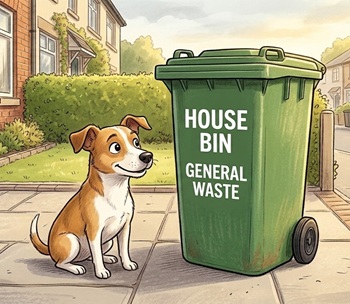
To an ordinary household, the rhythmic rumble of plastic wheels on paving slabs might signal nothing more than a routine task. To Milo, however, escorting the wheelie bin to the kerb is a high-level security operation requiring absolute precision and unflinching resolve.
The mission commences every alternate Thursday morning at precisely quarter-past seven. As soon as the back door unlatches, Milo steps onto the driveway, his ginger head held high, his ears perked forward, and his tail pointed straight up like an aerial. He assumes his position three inches to the left of the bin, acting as an official escort to ensure the heavy green container stays strictly on course and does not veer toward the flowerbed.
As the bin rolls toward the front gate, the neighbour’s black and white cat—a notorious intruder—appears atop the fence post, attempting to inspect the proceedings. Milo does not break stride. With a confident, measured gaze and a sharp, authoritative “Woof!”, he sends a clear message: This driveway is under official surveillance. The cat wisely decides to retreat behind a chimney pot.
Reaching the kerb, Milo conducts a swift final inspection. He trots around the wheels, sniffs the edge of the paving slab to confirm the placement is spot-on, and sits down smartly beside the handles. He stays glued to the spot until the dust cart’s distant engine echoes down the avenue, satisfied that the bin is completely secure and the neighbourhood remains in order.
With his duty impeccably fulfilled, Milo turns and struts back up the driveway toward the front door, ready to march straight into the kitchen and demand his well-earned morning biscuit.
-
Anonymous Autist’s Guide To The Galaxy – The Unbearable Weight Of Massive Talons

Have you ever sat down for a five-minute rest and a quick look at the news, only to discover that hours have passed, you’ve missed your dentist’s appointment and forgotten lunch (again), but somehow acquired savant-level knowledge of quantum theory, the life story of your third-favourite band and a novel explanation for why the ringing in your ears might not be tinnitus?
Do you know the conclusion to somebody’s story, its three possible objections and where they left their car keys while they’re still saying, “And you’ll never guess what happened next…”?
Perhaps somebody has announced that your “quirks” have suddenly become “more noticeable”, despite your distinctly inconvenient recollection of having possessed them for your entire existence.
If so, you may be affected by Quantum Talons: rare, invisible particles whose discovery could change human understanding forever.
THE PROBLEM: MAKING THE INVISIBLE VISIBLE
Scientists, some of whom are convinced they have unusually large brains, confidently discuss electrons, neutrons, bosons, nonsons and other fake-sounding particles. Yet they have inexplicably overlooked the talon: an apparently massless particle with the gripping power of a peregrine falcon and the social consequences of replying “You too” when a waiter says, “Enjoy your meal.”
Talons attach themselves to sensory systems, communication, routines, interesting facts and the irresistible urge to autocomplete other people’s sentences. Their name is unusually appropriate: they grip your attention, pierce your tolerance for unexpected noises and refuse to let go of a fascinating subject until you know what happened to its inventor’s second cousin. Nobody can see them, yet their presence is felt as clearly as an ambiguously worded email dumping ten tonnes of confusion on your doorstep.
Measuring this effect has frustrated scientists, who prefer precise units over descriptions such as “a supermarket at rush hour with one cashier chatting while ten people materialise in front of me”, “a cheese-grater attached to a power drill scraping a blackboard” or “chewing metal-flavoured slugs”.
Fortunately, an independent group of 42 people with lived experience of Talonism has identified three governing principles. Their paper was submitted for my peer review following the traditional Talonistic Ritual: several hours of joyous hand-flapping, an improvised themed rap battle and an extended session of the “Forgetting to Eat” fasting method.
Their findings follow.
PRINCIPLE ONE: THE SOCIAL OBSERVER EFFECT
Quantum mechanics allows a system to exist in a superposition of possible states until measurement produces an outcome.
Our Grand Unified Theory of Talonism (GUTT) proposes that a Massively Talonted Individual can simultaneously be thoughtful, anxious, fascinated, exhausted, happy, overwhelmed and trying to remember when they last ate.
This state persists quite happily until an observer approaches with a mental clipboard.
Observer: “Why aren’t you looking at me when I’m talking to you?”
Massively Talonted Individual: “…”
Measurement complete. State recorded: RUDE.
Later, the observer witnesses the same individual deliver an impromptu two-hour lecture on the encyclopaedic history of intergalactic 4D film director Quantum Taneutrino, apparently on one breath, while making laser-focused eye contact powerful enough to transfer information directly into the brains of anyone still awake.
Measurement complete. State recorded: ATYPICAL SOCIAL COMMUNICATION.
Finally, the individual appears relaxed and happy at a social gathering.
“Doesn’t fit my understanding of Talonism,” announces the observer.
Measurement complete. Verdict: DEFINITELY NOT TALONISM.
The problem is not observation. It is mistaking an observer’s subjective interpretation for the entire universe. A complex internal experience has collapsed into a single label on somebody else’s clipboard, with contradictory evidence carefully excluded. Curiously, the observer believes the individual has changed state. The individual, still deciding whether the background humming is coming from a light fitting or another dimension, has detected no such transformation.
This is Premature Determination of Talonistic Social Decoherence (PDTSD): the moment a preconceived interpretation solidifies into a Solidified Truly False Upinion (STFU). An Upinion resembles an opinion but has been uprated by its owner on the grounds that they are incapable of being wrong, also known as the Brick Wall Effect.
Recommendation: Request repeat observation under laboratory conditions, with reduced lighting, clear instructions and an observer sufficiently open-minded to contemplate being mistaken.
Known drawback: Such requests may be recorded as “being difficult”, initiating a second decoherence event in which all contradictory evidence disappears into an Ego-Class Black Hole.
PRINCIPLE TWO: THE HYPERFOCUS–TIME-DILATION PARADOX
Einstein demonstrated that time is relative. Unfortunately, he lived before the internet and could not calculate the time-dilating effects of an interesting Wikipedia article.
Externally, a person experiencing Talonistic Hyperfocus appears stationary. Their tea remains untouched. The same song repeats. Nothing progresses except the clock, which has advanced five hours without permission.
Internally, however, the Stationary Talon Intake Machine (STIM)—an advanced biological quantum computer—is running six simultaneous research projects, reorganising an imaginary filing system, rehearsing next week’s social event and debating whether those last two activities technically count as additional projects.
This appears to be “doing nothing” to the untrained observer. In reality, it is extraordinarily concentrated cognitive energy, whose mass cannot be determined because the subject has forgotten to stand on the scales.
In conversations, the STIM may approach the speed of light while the other person approaches the point at a rather more leisurely pace. According to the Equal and Opposing Conversational Delay Principle, the two velocities cancel perfectly. The observer sees a motionless listener. The listener is already mentally at home, composing a follow-up email about the conversation and wondering whether it actually took place.
The STIM may also explain Pre-Cognitive Sentence Completion. By receiving Advanced Waves from the future, the Talonted Individual hears the end of a conversation, travels back to the present and supplies it before the other person reaches the point.
“That’s exactly what I was going to say!”
“I know. I’ve already heard it.”
This saves considerable time but carries an unfortunate risk: the interrupted speaker may restart their explanation, trapping both participants in an entangled conversational loop. The only known escape is to pretend the kettle has boiled.
Recommendation: Schedule food, self-care and deep-dives. Deploy tactical alarms. Practise resisting the urge to [insert Pre-Cognitive Sentence Completion here].
Known drawbacks: Alarms may terminate a productive nine-project session after only seven projects. Alternatively, the time saved may be entirely consumed waiting ten minutes for somebody to finish a point understood in the first eight seconds.
PRINCIPLE THREE: RELATIVISTIC TALONISM AND DIMENSIONAL COMPRESSION
Despite the overwhelming conclusions of our research programme, some observers cling to archaic views of Talonism. Occasionally, however, they undergo spontaneous recovery, reverse their STFU state and forget ever having believed that Talonsim didn’t exist.
To understand this, consider Relativistic Talonism, which proposes that related Talonted Individuals may display similar characteristics. These similarities can generate Talonistic Resonance, making each person’s traits seem so ordinary to the other that neither notices them.
Under Dimensional Compression, a small change in viewing angle—or perhaps sufficiently tolerable lighting—disrupts the resonance. Differences previously hidden in plain sight become visible, and both individuals may suddenly recognise their own Talonism.
Nothing about their underlying neurology has changed. Only the frame of reference has.
The resulting discovery can produce an unusually harmonious, almost Yin–Yang form of entanglement: mutual understanding, freely displayed quirks and an exponential increase in conversations about special interests.
What one person previously interpreted as a peculiar habit becomes a shared operating instruction; what the other once concealed requires no elaborate translation. Individual thought processes may still occupy several parallel dimensions, but the two universes now have an agreed communications protocol.
An external observer, noticing these interactions for the first time, reaches for the clipboard.
Measurement complete. State recorded: DEFINITE TALONISM.
Recommendation: Ask a relative about their favourite subject. If you cannot get a word in edgeways, they may be Talonted. If you urgently need to interrupt with your own unrelated special interest, you may both be Talonted.
Known drawback: A STIM Feedback Loop can create a mutually accelerating exchange of interesting facts in which nothing practical gets done, including lunch.
FINAL GUIDANCE: NEVER JUDGE A TALON BY ITS COVER
Invisible things are easy to dismiss if you have never experienced them. Someone can look motionless while expending extraordinary effort, seem composed while overwhelmed, or appear to have changed simply because somebody finally noticed what was always there.
The weight of massive Talons cannot be determined by what an observer can see. Sometimes the heaviest part is carrying an invisible load while being told there is nothing there.
So, before making your next observation, remember: you are not looking at the whole universe. You are looking through one small window of a spaceship travelling at an entirely unreasonable speed, with spacebugs splattered across the glass, confidently describing things you cannot—or refuse to—see.
Join us next time as we crank the Hyperfocus Drive up to 11 and discover one of the universe’s most unusual dances: The Denial Twist – Dancing in the Gaslight.
-
Townsend’s Quiz Time

Questions:
(1) Which British presenter and journalist, who founded the charity Childline, died in September 2026?
(2) Which former American Football player portrayed the character Julius Rock in the sitcom “Everybody Hates Chris”?
(3) What is the capital of Somalia?
(4) Who was the queen of gods in Greek mythology?
(5) Old documents containing accounts similar to the Bible were discovered in 1947 in caves in the desert near Jericho. What name has been given to them?
(6) “To the Lighthouse” and “Mrs Dalloway” are novels by which author?
(7) Sarah Dallin and Keren Woodward are members of which iconic British girl band; they were prominent in the 1980s?
(8) Which city’s NHL team is nicknamed the Sabres?
(9) What is a leylandii?
(10) Who is known as the “Father of the Indian Nation”?
(11) What is the currency of China?
(12) How many elements are currently in the periodic table?
(13) What is the study of fossils called?
(14) Which bird is considered a symbol of peace?
(15) Who painted the Mona Lisa?
(16) Which mammal ranks as the largest animal on Earth?
(17) Which Formula 1 driver is known for racing with the number 44?
(18) Which Italian tenor rose to fame in 1994 after winning the newcomers’ section of the 44th Sanremo Music Festival?
(19) What toy is associated with the Jewish celebration of Hanukkah?
(20) FODMAPs are carbohydrates that move slowly into the large intestine. What does FODMAP stand for?Answers:
(1) Esther Rantzen (2) Terry Crews (3) Mogadishu (4) Hera (5) Dead Sea Scrolls (6)
Virginia Woolf (7) Bananarama (8) Buffalo (9) A coniferous tree (10) Mahatma
Gandhi (11) Chinese Yuan Renminbi (12) 118 (13) Palaeontology (14) Dove (15)
Leonardo da Vinci (16) Blue whale (17) Sir Lewis Hamilton (18) Andrea Bocelli (19)
Dreidel (20) Fermentable Oligosaccharides, Disaccharides, Monosaccharides, and
Polyols
-
The Owl And The Pussy-cat
The Owl and the Pussy-cat went to sea
In a beautiful pea-green boat,
They took some honey, and plenty of money,
Wrapped up in a five-pound note.
The Owl looked up to the stars above,
And sang to a small guitar,
‘O lovely Pussy! O Pussy my love,
What a beautiful Pussy you are,
You are,
You are!
What a beautiful Pussy you are!’
Pussy said to the Owl, ‘You elegant fowl!
How charmingly sweet you sing!
O let us be married! too long have we tarried:
But what shall we do for a ring?’
They sailed away, for a year and a day,
To the land where the Bong-tree grows,
And there in a wood a Piggy-wig stood,
With a ring at the end of his nose,
His nose,
His nose,
With a ring at the end of his nose.
‘Dear Pig, are you willing to sell for one shilling
Your ring?’ Said the Piggy, ‘I will’.
So, they took it away, and were married next day
They dined on mince, and slices of quince,
Which they ate with a runcible spoon;
And hand in hand, on the edge of the sand,
They danced by the light of the moon,
The moon,
The moon,
They danced by the light of the moon.
EDWARD LEAR (1812 – 88)
-
Cheesy Leek Flan

Ingredients:
- 8 oz of baked shortcrust pastry
- 1 oz of butter
- 1 oz of plain flour
- 1lb of leeks
- ½ pint of milk
- Seasoning
- 1 level teaspoon of mustard
- 4 oz of grated cheddar cheese
Method:
- Cut leeks into ¼-inch thick rings and wash well.
- Melt ½ oz of butter in a pan and add the leeks. Cover the pan and cook gently for 2-3 minutes. Melt the remaining butter in the pan and stir in the flour.
- Add milk stirring well and cook well until sauce is smooth and thick. Stir in the mustard and 3 oz of grated cheese and season to taste.
- Spoon leeks into baked, hot flan case, top with sauce and sprinkle with remaining cheese.
- Bake in oven at gas mark 6/400 F for 15 minutes.
-
Deep Fried Fritters

Ingredients:
- 1 large potato
- 1 large cooking apple
- 2 egg whites
- Fat for frying
- A pinch of cinnamon
- Salt
Method:
- Peel the potato and grate, pouring off the excess water. Peel the apple, remove the core and grate into the potato. Add the cinnamon and salt.
- Whisk the egg whites stiffly and fold into the potato and apple.
- Fry spoonfuls in hot, deep fat until golden brown. Serve with ham or pork.
-
Steamed Jam Pudding

Ingredients:
- 4 oz of self-raising flour
- 2 oz of sugar
- 2 oz of suet
- 3 tablespoons of jam or lemon curd
- 2 tablespoons of milk
- Pinch of salt
Method:
- Mix dry ingredients together. Add the milk. Put jam or lemon curd at the bottom of a greased basin. Add the mixture (which must be stiff).
- Have ready boiling water in a large pan, pudding covered and securely tied. Stand the basin on a perforated rack or two skewers with the boiling water two thirds the way up the basin. Fit the lid.
- Cover and steam for 1 ½ hours. Water must boil throughout and be replenished as required.
-
Chocolate Potato Cake
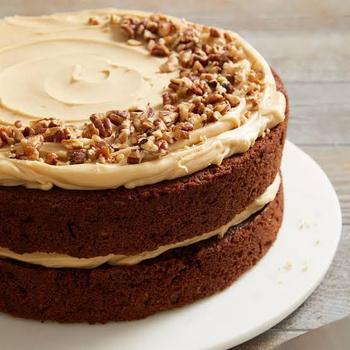
Ingredients:
- 3 oz of mashed potato
- 4 oz of butter or margarine
- 6 oz castor sugar
- 2 eggs
- 6 oz of self-raising flour
- 1 ½ oz of melted chocolate or 4 level teaspoons of cocoa
- 4 tablespoons of milk
- ½ level teaspoon of salt
Method:
- Cream the fat and sugar thoroughly with the mashed potato. If melted chocolate is used, add it to the creamed mixture. Beat the eggs and stir in. Add the sifted, dry ingredients and mix well. Add the milk to make the mixture a soft, dropping consistency.
- Divide the mixture evenly between two 8-inch tins and bake in a moderate oven at 375 F/gas mark 5, for 25-30 minutes. Make sure it is quite firm and springy on top when pressed lightly.
- Turn out on a rack to cool. Sandwich together with any filling, then ice and decorate as desired.
-
Grilled Cinnamon Oranges

Ingredients:
- 4 large oranges
- 1 teaspoon of ground cinnamon
- 1 tablespoon of demerara sugar
Method:
- Preheat the grill to high. Cut the oranges in half and discard any pips using a sharp or curved grapefruit knife.
- Carefully cut the flesh away from the skin by cutting around the edge of the fruit. Cut across the segments to loosen the flesh into bit-sized that will spoon out easily.
- Place the orange halves, cut-side up, in a shallow heatproof dish. Mix the cinnamon with sugar in a small bowl and sprinkle evenly over the orange halves. Cook under the preheated grill for 3-5 minutes or until the sugar has caramelised and is gold and bubbling. Serve immediately.
-
What Is Wrong With The British Record Buying Public?

This article is inspired by friend and Mad Wasp Radio DJ Mark Taylor. It is a catchphrase he uses to describe songs that were not hits on the British singles chart. I should also credit his colleague Alan Read as some of the inspiration also comes from a show they present called the “Pop Injustice League”.
Rather than looking at individual songs, I will be looking at British bands or artists that have been more successful in countries other than Britain. Some of these artists have ultimately been successful in the UK but were initially more famous elsewhere.
The first band I am going to talk about, they were the ones who came to mind when I first settled on this topic, are Bush. Fronted by Gavin Rossdale, former husband of fellow music star Gwen Stefani, their debut album “Sixteen Stone” broke them big time in the USA. Whilst songs like “Glycerine” and “Comedown” became instantly recognisable over there, their lesser profile in the UK meant they barely scratched the surface here. They were very popular during the era when contemporaries like Nirvana, Pearl Jam and Soundgarden were all the rage Stateside. “Sixteen Stone” was an immediate hit there in 1995 whilst their first, and to date only UK top ten single didn’t come until 1997 with “Swallowed” which was taken from their second album “Razorblade Suitcase” ironically, to date, their only UK top ten album!
Another band who came to mind are Def Leppard. The Sheffield based group initially rose to prominence in the US in 1983. Their album “Pyromania” reached number 2 on the Billboard album chart. From that album, “Photograph” reached number 12 on the Billboard singles chart and “Rock of Ages” reached number 16. “Animal” was their first UK top 40 hit single when it reached number 6 here in 1987! It was also in 1987 that they had their first UK number 1 album with “Hysteria”. “Pyromania” did reach number 18 on the UK album chart but this was a relative failure considering their success over the pond.
Other bands that deserve a mention from the 1980s are The Fixx, who had a Billboard number 4 single with “One Thing Leads to Another” in 1983, it also hit number 1 in the Canadian singles but only peaked at number 86 on the UK singles chart, the song came from the album “Reach the Beach” which reached number 8 in the US but only number 91 in the UK, and The Outfield who had a number 6 hit on the Billboard singles chart in 1986 but only reached number 83 in the UK. The accompanying album also reached number 9 in the US whilst it totally bombed in the UK!
I would say it is more difficult to assess the situation in the 21st century due to the way charts are now compiled. In my opinion, the inclusion of downloads as well as physical sales have clouded the picture somewhat. However, if we look at chart performance alone, bands such as Asking Alexandria, a North Yorkshire based metalcore band, who have achieved significant mainstream success in the US and Paradise Lost, a gothic metal band formed right here in Halifax, West Yorkshire have had significant success in Mainland Europe especially Germany, Finland and Greece.
These anomalies will no doubt continue to happen however, there is sometimes little the bands or artists can do about the situation, possibly due to the genre of music they perform sometimes.
I hope you have enjoyed reading what I have put together here. I would like to acknowledge the role Chat GPT and Wikipedia have played in helping me research the article.
-
Brenda’s Wildlife Corner
Jellyfish

Jellyfish (also known as jellies or sea jellies) are a fascinating marine animal that are found in surface waters and in the deep sea. They can also live in freshwater. Their body is composed of a bell shape with a collection of trailing tentacles underneath. Most jellyfish are free-swimming, but a few types are anchored to the seabed by stalks. Propulsion of the bell is provided by pulsing contractions with the stinging tentacles acting to capture prey and to prevent it becoming prey itself.
It is probable that jellyfish have existed for at least 500 million years which makes them the oldest multi-organ animal group – although they don’t have a nervous system. They are currently being studied to possibly aid medical research.
Interestingly, a group of jellyfish is known as a smuck or a smack; they are a delicacy in some Asian countries like: China, Japan and Korea even though about 95% of their body is composed of water. Their main predators are tunas, sharks, swordfish, sea turtles, penguins and other jellyfish.
The diet of a jellyfish includes: small fish, fish eggs, other jellyfish or planktonic food. A jellyfish is usually male or female though some are occasionally hermaphrodite. Sperm fertilises eggs and these become polyps before transforming into adult medusae. Sometimes a jellyfish lives for several years and is consumed by other mammals and birds when washed up on the beach.
The size of a jellyfish can range from minute to up 2 metres in bell height and diameter with the tentacles and mouth (which also acts as its anus) extending beyond the bell. One species called the Lion’s mane is extremely large but does not possess a deadly sting, Another, species, the Box jellyfish has very advanced vision with 24 eyes which enable it to view its environment from 360 degrees.
It can act as a host for some small fish which are immune to its sting; the fish can safely live amongst the tentacles and can act as bait in a fish trap both sharing what is caught.
Jellyfish are yet another example of the incredible world we all inhabit and we must try to conserve.
- Ref. Wikipedia
-
Words To Ponder
“He is not rich that possesses much, but he that is content with what he has.”
-
FTHM Fun Quiz

Questions:
- Where was the first public fire service created?
- Where was actor Audrey Hepburn born?
- What is the capital of the DR of Congo?
- How many states are there in the US?
- Who played the main male role in From Here to Eternity?
- What is a lute?
- Where was the inventor of the Cat’s Eye road stud born?
- Who invented the modern submarine for naval use?
- How old was Tommy Cooper when he died?
- What is common French word for Puppet?
- Who played Rodney Trotter in Only Fools and Horses?
- Who wrote Only Fools and Horses?
- How old was Neil Armstrong when he walked on the moon?
- What is the currency of the DR of Congo?
- Which is the largest planet in our solar system?
- Where was the first Walmart store?
- What is the Spanish word for cabbage?
- When were the Russian Revolutions?
- What nationality was actor Steve McQueen?
- Who won this year’s World Snooker Championship?
Answers: (1) Edinburgh in 1824 (2) Ixelles, Belgium (3) Kinshasa (4) 50 (5) Burt Lancaster (6) A pear-shaped, stringed instrument (7) Halifax, England (8) John Philip Holland (9) 63 (10) Marionette (11) Nicholas Lyndhurst (12) John Sullivan (13) 38 (14) Congolese franc (15) Jupiter (16) Rogers, Arkansas on July 2 1962 (17) Repollo (18) In February and October 1917 (19) American (20) Wu Yize
Editor’s Final Word
If you think you would like to get involved with this project, please contact us (in a non-racist, non-homophobic and non-sexist way) at: dean@fthm.org.uk
Please note that our website address is: https://fromthehorsesmouth.org.uk Dean
Thank you for taking the time and the trouble to look at this e-magazine. I do hope you will maybe feel inspired to join our project. If you want to know more about me (editor) please go to our website and click on Warts and Almost All. Also, a big thank you to all the people who have contributed to this edition.
Please note that our email address is: dean@fthm.org.uk and our website address is: www.fromthehorsesmouth.org.uk
Best wishes, Dean, Brenda, Graham, and Hari