Jellyfish
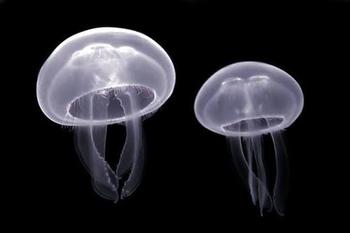
Jellyfish (also known as jellies or sea jellies) are a fascinating marine animal that are found in surface waters and in the deep sea. They can also live in freshwater. Their body is composed of a bell shape with a collection of trailing tentacles underneath. Most jellyfish are free-swimming, but a few types are anchored to the seabed by stalks. Propulsion of the bell is provided by pulsing contractions with the stinging tentacles acting to capture prey and to prevent it becoming prey itself.
It is probable that jellyfish have existed for at least 500 million years which makes them the oldest multi-organ animal group – although they don’t have a nervous system. They are currently being studied to possibly aid medical research.
Interestingly, a group of jellyfish is known as a smuck or a smack; they are a delicacy in some Asian countries like: China, Japan and Korea even though about 95% of their body is composed of water. Their main predators are tunas, sharks, swordfish, sea turtles, penguins and other jellyfish.
The diet of a jellyfish includes: small fish, fish eggs, other jellyfish or planktonic food. A jellyfish is usually male or female though some are occasionally hermaphrodite. Sperm fertilises eggs and these become polyps before transforming into adult medusae. Sometimes a jellyfish lives for several years and is consumed by other mammals and birds when washed up on the beach.
The size of a jellyfish can range from minute to up 2 metres in bell height and diameter with the tentacles and mouth (which also acts as its anus) extending beyond the bell. One species called the Lion’s mane is extremely large but does not possess a deadly sting, Another, species, the Box jellyfish has very advanced vision with 24 eyes which enable it to view its environment from 360 degrees.
It can act as a host for some small fish which are immune to its sting; the fish can safely live amongst the tentacles and can act as bait in a fish trap both sharing what is caught.
Jellyfish are yet another example of the incredible world we all inhabit and we must try to conserve.
- Ref. Wikipedia