
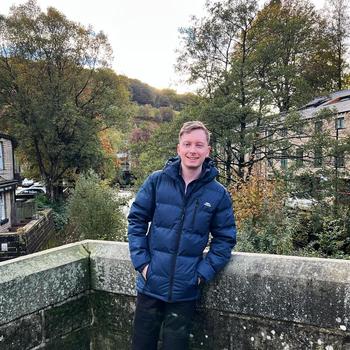
Can you begin, please, by speaking a little bit about yourself? I’m James. I’m the famous Australian that works at Costa in Halifax.
How old are you, James? 40 years old, nearly 41. I live in Hebden Bridge – my family’s old town.
And how long have you been in England? It’s just over four years now.
What made you come here? In 2013, I had a family reunion.
In England? In England. I’d never met the family before; I’d found all different names in my grandmother’s address book and contacted loads of different people. They recognised my name, and we arranged a family reunion. And then I flew over, and we went to this working men’s club in Burnley, and about 80 people turned up.
All family? Some of them. There’s a lot of a lot more than that, a lot of cousins. But 80 of them turned up, and then from then on, we got to know each other more and more, and I’ve been flying over almost every year, well about every year since then. And then after COVID ended and the lockdowns finished, life went back to normal, and me and my partner, Ash, were just feeling very unsatisfied. So, I asked “Would you ever consider moving back to the UK?” And Ash replied: “Oh actually, I was thinking about it as well.” And I said, “Well, let’s do it.” A couple of months later we’d packed up, sold everything, quit our jobs, and moved over, and that was that!
So, when you came here, where did you come to? Birmingham.
Why Birmingham? Well, Ash got a job at Well, it was at Flybe when they brought Flybe back from the dead. So, we lived there. I worked in Solihull.
Doing what? At Costa, as soon as I was ready to get a job.
Did they train you up in Solihull then, or were you already trained up? Well, I was already a barista in Australia although everything’s a little bit different there. I had to learn how they do it here and at this company, but it was all pretty fast. It wasn’t hard. Birmingham was where we started off. It wasn’t bad where we were, to be fair, it was quite nice.
Why did you leave Birmingham? Flybe went under, so, Ash needed to get a new job.
Well, where did you go to then? We went down to Bedford, because Ash got a job in Luton.
Doing what? With TUI, TUI Airlines.
Is that his past, aeroplanes? All of that, yeah. We’ve both worked in aviation in the past; Ash always has. So, we went to Bedford, which was the nicest place I could find in the area to live near Luton. And I just got a transfer, because it’s Costa, you can just transfer wherever you want. We were there for another year, and then we got sick of it, and we looked at houses up this way, because I came to Hebden Bridge two, three times a year anyway. Then we just applied for a house, and it worked out. And it was like a rollercoaster, the process just went crazy, and then we had a house before we knew it.
When you came to England, did you have to make any sort of adjustments? Or are the English very like the Australians? It’s very similar, but I had a few surprises. Strangers are a bit more talkative here than in Australia. In Australia, people are a lot more guarded, but it’s mostly because it’s all big city mentality and you’re afraid when someone talks to you. My first proper interaction was in a B&M and I was just looking around and this woman was browsing at Christmas trees or something, and started talking to me. I got my guard up, and a little bit nervous, because I’m thinking: is she on drugs? Is she crazy? Is she going to ask me for money? Is she going to rob me? And we had this great conversation, for about 10 minutes, and then she just went off and bought a Christmas tree! And I’m like, what on earth was that?
That was a social education, wasn’t it? It was, because I was like, okay, something’s different here. And then that sort of thing happened loads more times, and I had to understand that there’s a different social side here – even in the Midlands.
Have you ever been to London? I’ve been to London a few times.
And did you find people friendly in London? I thought they were friendlier than in Australia.
Not like in the North of England, though? Nothing like the North at all, not even a slight comparison. It was very similar to Melbourne socially, but a I think a little bit friendlier.
And what do you like about living in Hebden Bridge? The beauty is probably the number-one thing. I like that I’m so close to where my family have been for generations as well. I feel a bit of a meaning for where I live which matters to me. I feel like I belong there just because we have history.
Do you think it’s a more tolerant place than some other places? I’ve never personally had any trouble, so, it’s really hard for me to honestly answer that. I think however, that people are very one-directional in their thought. They’re not very open to multiple ways of thinking. I think you have to go along with one mindset, and I’m very much about people should have, whether you like it or not, their freedom of expression. I’m for all that. I don’t really like people restricting other people’s mindset whether you like it or not, and I think that is very rigid in a place like Hebden Bridge, but that it is more open than in the city.
And how did you meet Ash? I knew Ash a little bit in Adelaide where I came from originally. Just because everyone knows everyone, it’s a very small city. And then I moved to Melbourne, and I was working on the same street as Ash was working at. Ash was working for an airline in Melbourne, I was working in a department store, and we bumped into each other walking down the street.
All right, and you got on straight away? Well, we recognised each other” and said: Oh my god, you’re from Adelaide.” So, we’re like, “Oh, we’ll go for a coffee.”
It grew, the relationship? Well, it didn’t take very long. It took only a few weeks. I lived with a housemate who was completely nuts, very crazy. A couple of weeks after that, I moved in as I had to move out of the other place or I was going to commit murder!
Is it true that your ancestors were Ten-pound Poms? That’s 100% true.
How did that come about? Do you know about it? I do; I know a lot about it. My grandfather, my grandmother, and my mum all lived in Hebden Bridge. And, my grandfather, was typically in control of the household.
It was very patriarchal at that time, wasn’t it? It definitely was. And he always wanted to get away from his family.
He was adventurous? Adventurous, he went and lived in Hong Kong for years when he was younger. He joined the army the second he could. His family were quite big-time criminals; they were loan sharks and all sorts.
In England? Over in Burnley, they were quite notorious at the time.
Is that where you family originated, from Burnley? Between Burnley and Hebden Bridge.
One thing that interests me is what was your education was like in Australia? Was it basically state education? Yeah, primarily. Public school in Australia is just like your government education here; private education is your expensive, fancy one.
Was yours a public school? Yeah.
Did you feel jealous of people who went to private school? I did in high school, yeah.
Because they were getting a better education? 100%. My school was really terrible, it was terrible.
And do you think, like here in England, that there’s an old-tie school network where people get jobs because of who they know? Definitely The interesting thing in Australia when it comes to those kinds of schools and that kind of education, is that people pretend that there’s no class system, but they just don’t say it, but it still exists in practice.
Is it three-tier class system in Australia, like here in Britain? I’d say it behaves the same, it’s just we don’t have a word for it, because people pretend that they don’t have one, because they want to feel like they’re better: “We’re better than Britain, we’re better than the UK, we’re better than where we came from, we don’t have a class system.” But they do, it’s just unspoken.
So, what was your favourite subject at school? Either German, I was very good at that, or biology. I loved biology. But then again, I love plants. I’m obsessed with plants.
You did a degree, didn’t you? Yeah. My degree was an honours degree in psychology.
What made you choose that subject? A lot of people with issues gravitate towards doing psychology studies because they’re interested and they think that maybe it’ll explain something about yourself. However, that’s often not how it works out. You get the education, but it doesn’t help you, it’s more as if you’re helping someone else. A lot of people with mental illnesses gravitate towards this degree even if they’re not suitable to work in that field.
Do you think mental issues are hereditary? Definitely. I wasn’t suitable for work in that area, but that’s what I did.
And were you brought up in a traditional, nuclear family? Not at all.
Well, who brought you up? My dad left when I was 6, then I lived with mum till I was 10 when I ran away from home.
Where did you go to? I just ran away, and then I got picked up by the police.
The same day? That second time, yeah. And then, I got sent to my grandmother’s. She didn’t tell me till she was on her deathbed that the judge had said, “We want you to take the child,” so, she had to say “yes”.
Was she a good surrogate mother then? A bit of both. When she was normal, she was very good. We were very similar in nature, and then when she had these episodes, it was a sort of a nightmare. It was like a two different Jekyll and Hyde kind of thing, and that was really hard.
Do you think she did her best for you? I think so. It’s very hard to look back on it with a really clear mind.
Did she have money to support you? She was fine. She was from Yorkshire and was very miserly. But she had a lot in the bank, though she wouldn’t send me to a better school. I knew she had lots of money.
And when you were at school, were you interested in sport at all? I was into kickboxing, taekwondo, badminton. I was very competitive.
Did that reflect your personality then? I think so. I was very energetic.
Do you do any sport now? No
Are you too old for sport now? Probably not too old, but I think my breathings not too good.
Did you have a problem with your heart? I did. We were training to qualify for the Olympic team for taekwondo, when I got a Staphylococcus infection that went into my heart valve, and that took me down for two or three years.
Could you have died from it? Probably if I was another day without the hospital and I hadn’t been so fit.
If somebody said to you, what are the attractions of living in England, what would you say? I recommend anyone to give something a go if they’re curious and they can. A matter of perspective is that we all look on a different place with rose-coloured glasses.
The grass is greener? Absolutely, and everyone does it. They do it in Australia, they do it here. They do it a lot here. But, there’s a lot of things that foreigners find very fascinating when they come here, and that doesn’t really end once you’ve moved here. We find the history, the beauty, the sights very interesting.
It is rich in history, isn’t it? There’s so much here to experience here, if you want to get out and explore.
Do you like the Royal Family? I’m indifferent. The Royal Family is bigger in Australia than it is here, believe it or not. I’m neither here nor there, really.
And how do you find the cost of living in England? I find it the same, it’s no different. Some things differ like electricity is more expensive in Australia.
And do you like working at Costa in Halifax? I think this is probably the best job I’ve had.
Do you like the people here? The people are brilliant.
Do you like the customers? The customers are great, compared to other places I’ve been when I’ve worked in customer service. But certainly, here at Halifax, it’s overwhelmingly good.
And the staff are lovely? The staff are brilliant. We’re more family-orientated, I think, and that’s why we talk and we interact with everyone.
And have you any hopes for the next, say, five years – or in the near future? My total focus is on my home.
You incorporate wildlife into your home, don’t you? I do. I’m working on building my wildlife pond at the moment.
Why are you doing that? I want any bit of land that I work on to contribute environmentally. My front garden, my normal front garden, every part of the design is environmental. There are insect hotels all over the walls.
Does Ash share your interest in nature? He appreciates the beauty of it, but he doesn’t have the skills, so he just looks at it.
So, you do all the labour that’s involved? I do all of it, but that’s my enjoyment and my pleasure. I don’t really want anyone else to get involved anyway.
Are you happy with your home? Yes.
Do you feel happy being there? It’s the first time I’ve really had a proper home. I’ve never lived anywhere for more than a couple of years. This sense of stability, is very nice, it’s very luxurious because I’ve just never had it, and it takes a lot of adjusting to, even for something positive, to go, “Oh, this is home.” because you get a little vigilant going, “Oh, maybe I’m going to have to move again, maybe,” and you forget, “Oh hang on, I need to stop that mindset.”
So, you can relax more mentally here? You have to learn that though, it isn’t an instant process of, “Oh, I’m here forever.” You really have to change your default way of thinking after decades of moving around.
And finally, have you got anything that you’d like to add to this interview? Well, I want to add that as someone who’s moved here, and someone who’s Australian and jumping into the culture, and the area and Yorkshire and the area, you know, it’s so pleasant from my perspective and my culture to be somewhere where you can interact and talk and get to know people so easily, and to feel less like an inanimate object and more like a human being.
You’ve been made to feel at home here? Well, when you walk down the street and there’s people you say hello to, or you could be at a bus stop and someone’s talking to you, or just random things like that, you feel like you’re not invisible any more. And I think that’s the huge benefit of leaving the big city and coming somewhere like Halifax. It humanises you, and you feel, right, and you feel like a person. I think that’s something that a lot of people need to appreciate a hell of a lot more here.

